
Stump removal in Beaverton, Oregon
Grinding hides a stump. Removal gets rid of it. When a patio, a footing, a fence post or a new tree is going exactly where the old tree stood, we dig out the stump and its main roots, then backfill and compact the hole so the ground stays where you put it.
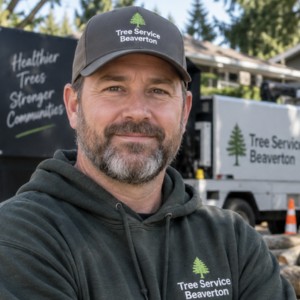 Harry Fauver, founder. Updated September 2026.
Ground down, or taken out?
The difference shows up a few years later.Ground only
Grinding takes the top of the stump down a few inches below the surface. Everything under that stays: the base of the stump, the big roots and a bowl of chips. For lawn and planting beds that is fine, and it's the quicker job. See stump grinding.
Ground, then built on
Buried wood doesn't stay put. Over three to ten years it rots and shrinks, the chips compress, and a hollow opens up under whatever was built on top. Pavers dip, a slab cracks along the line of the old root, a fence post starts to lean. The fix at that point means taking up what you built.
Removed and backfilled
The stump and its main roots come out whole. Remaining roots are cut cleanly at the edge of the hole, which is then refilled with mineral soil in layers, each one compacted before the next goes in. What you build on it rests on ground that has nothing left in it to rot.
Grinding or removal: which does your spot need?
It comes down to what is going on the spot next. Pick it from the list.
Pick what is planned for the spot and the answer appears here.
Grinding is enough.
A standard grind, the chips hauled, topsoil and seed. There is no reason to dig a large hole in a lawn. Expect to top up the soil once as the old roots settle.
A deep grind is usually enough.
Ask for 10 to 12 inches so shrubs and perennials root into soil, not wood. Go to full removal only if the old tree died of a root disease such as honey fungus, which can move from the dead roots into new plants.
Remove it, or move the new tree over.
A young tree planted into grindings sits in rotting wood that robs nitrogen and then collapses under the root ball. If the new tree can go a few feet to one side, grinding is fine. If it has to go in the same hole, as replacement street trees often do, take the stump out.
Remove it if a post lands on it.
A post set in concrete needs undisturbed or compacted soil around it. If the fence line can shift so that no post falls on the old stump, grinding will do. If a post has to stand there, the stump comes out.
Remove it.
Pavers and poured paths show every bit of settlement. The base under them needs to be compacted gravel on firm soil, and that can't be built over buried wood.
Remove it, and ask your builder about compaction.
Footings carry real loads, and an inspector may want to see what they bear on. We take the stump and roots out and either backfill to the builder's requirement or leave the hole open for the footing crew.
Remove it.
Vehicle loads find every soft spot. A driveway poured over a ground stump will crack along the old roots within a few years. Full removal and compacted fill are the only reliable base.
How a stump comes out
Taking a stump out is excavation, and how we do it depends on the stump's size and how we can get to it.
- Dig and expose. A trench goes around the stump, wide enough to work in, until the main roots are in the open. Where a compact excavator fits through the gate it does the heavy digging. Where it doesn't, it's shovels, a digging bar and patience.
- Cut the roots. Each root is cut clean at the edge of the hole with a root saw or an axe, so the part that stays isn't torn and whatever is on top of it, such as a sidewalk, a fence footing or a neighbor's lawn, isn't lifted.
- Lift it out. Once it is free, the stump is rolled or winched out. A large fir stump with soil on it can weigh as much as a small car, so it is often cut into pieces in the hole. Nobody should ever try to yank a stump out with a truck and a chain: chains break, and hitches come off.
- Backfill and compact. The hole is refilled with soil in layers 6 to 8 inches thick, each one compacted before the next goes in. Grindings, sod and organic topsoil don't go in the bottom of a hole that will be built over, because they rot and shrink.
What is under there
Stump removal goes deeper and wider than grinding, so the utility locate matters even more. We request an 811 locate for every job, which takes at least two business days in Oregon, and we hand dig within 24 inches of any marked line. The locate doesn't cover private lines. Sprinkler pipe, lighting wire, a gas line to the grill and, on county lots, the septic system are all yours to point out.
Beaverton's soil
Most of the valley floor is silt loam over clay, the Aloha and Woodburn soils you see on county maps. It drains slowly, and in winter water perches a foot or two below the surface. An open hole dug in January fills with water overnight and can't be compacted properly until it dries out. If the project allows it, stump removal is a dry-season job, from late spring to early fall.
Foundations, walls and sidewalks
Close to a foundation or a retaining wall we dig by hand and stop short of the footing. Often the right answer there is a mix: dig out the side that faces the project and grind the side that faces the house. Roots that have grown under a sidewalk are cut at the slab's edge and left. Pulling them is how sidewalks get broken.
Local notes
Planting strips. A stump between the sidewalk and the curb is in the public right-of-way. Digging there needs the city's permission, and when the tree was removed under a street tree permit a replacement is normally required. Full removal is usually what makes room for the new tree.
Root disease. Laminated root rot in Douglas-fir and honey fungus in many species live on in dead stumps and roots for decades. Taking out the stump and the large roots removes most of that food base. For replanting on such a spot, hardwoods, western redcedar and pines hold up far better against laminated root rot than another Douglas-fir or a grand fir.
Ash. Ash stumps and roots stay inside the emerald ash borer quarantine area, which includes all of Washington County.
Afterward: building or replanting
If you are building
Tell us what is going on the spot and who is building it. For pavers and shed pads we backfill and compact to finished grade, less the depth of your gravel base. For footings, most builders prefer that we leave the hole open and clean so they can pour onto undisturbed soil. Either way it is written on the estimate.
If you are replanting
Soil for a tree should be firm, not hard. We backfill with the native soil, lightly firmed, and leave the top loose for planting. Pick a species that suits the space. Under wires and in narrow planting strips that means a small tree, and for street trees it means one from the city's approved list. Tree planting right after a removal works well here in fall, when the rain does the watering for you.
Before we dig
- Show us the plans or mark the footprint of what you are building, so we dig where it matters.
- Measure the narrowest gate. Machine access decides how long the job takes.
- Flag private lines and sprinkler heads.
- Decide where the spoil goes. Removing a stump makes a pile of soil and wood about twice the size of the hole. We can haul it.
Related services and guides
Stump removal questions
What is the difference between stump grinding and stump removal?
Grinding shaves the stump down below the lawn and leaves the roots to rot in place. Removal digs out the whole stump and its main roots and refills the hole with compacted soil. Grinding suits lawns and beds. Removal suits anything built or planted on the same spot.
When is full stump removal worth it?
When something that must not sink or shift is going on the spot: a slab, a footing, a paver patio, a driveway, a retaining wall or a fence post. Also when a new tree has to go in the same hole, or when the old tree died of a root disease.
How big a hole does stump removal leave?
Usually two to three times the width of the stump, and as deep as the main roots run, often 2 to 3 feet. We backfill and compact it the same day unless you want it left open for a footing or a new tree.
Can you remove a stump next to a foundation or sidewalk?
Yes, with care. Roots running under concrete are cut cleanly at the edge, not pulled, so the slab isn't lifted. Right against a foundation we often grind the last part instead of digging, to avoid disturbing the footing.
Do I need a permit to dig out a stump in Beaverton?
Not on your own lot in most cases. The planting strip is different: digging in the public right-of-way needs city permission, and a removed street tree normally has to be replaced. We sort that out before the job.
Can I build on the spot right away?
On properly compacted fill, yes for light structures such as a shed pad or a paver patio. For a poured footing or anything engineered, your builder or inspector sets the compaction requirement, and we backfill to that or leave the hole open for them.
Request an estimate
Tell us about the tree and we'll call to set up a site walk. For emergency service, skip the form and call.